

Welcome to post number 50.
When I started “Financial You”, I had a simple goal. I wanted to create the kind of open, judgment-free space for money conversations that I wish I had earlier in my life.
Fifty articles later, we have covered a lot of ground. We have explored everything from the emotional weight of debt, to the mechanics of index funds, and the philosophy of spending. But sometimes, when you are deep in the weeds of writing (or reading) every other week, it is hard to see the forest from the trees.
I wanted to take a step back and see if a cohesive picture would emerge from the last two years of work. So, I tried an experiment.
I fed all 49 previous posts into an AI tool (NotebookLM by Google) and asked it a simple question: “How would you make sense of all this content?”
The result was a mind map that organized the essence of this blog into five distinct pillars. It made me realize that “Financial You” isn’t just a collection of tips. It has evolved into a holistic system.
Here is the framework that we have built, pillar by pillar.
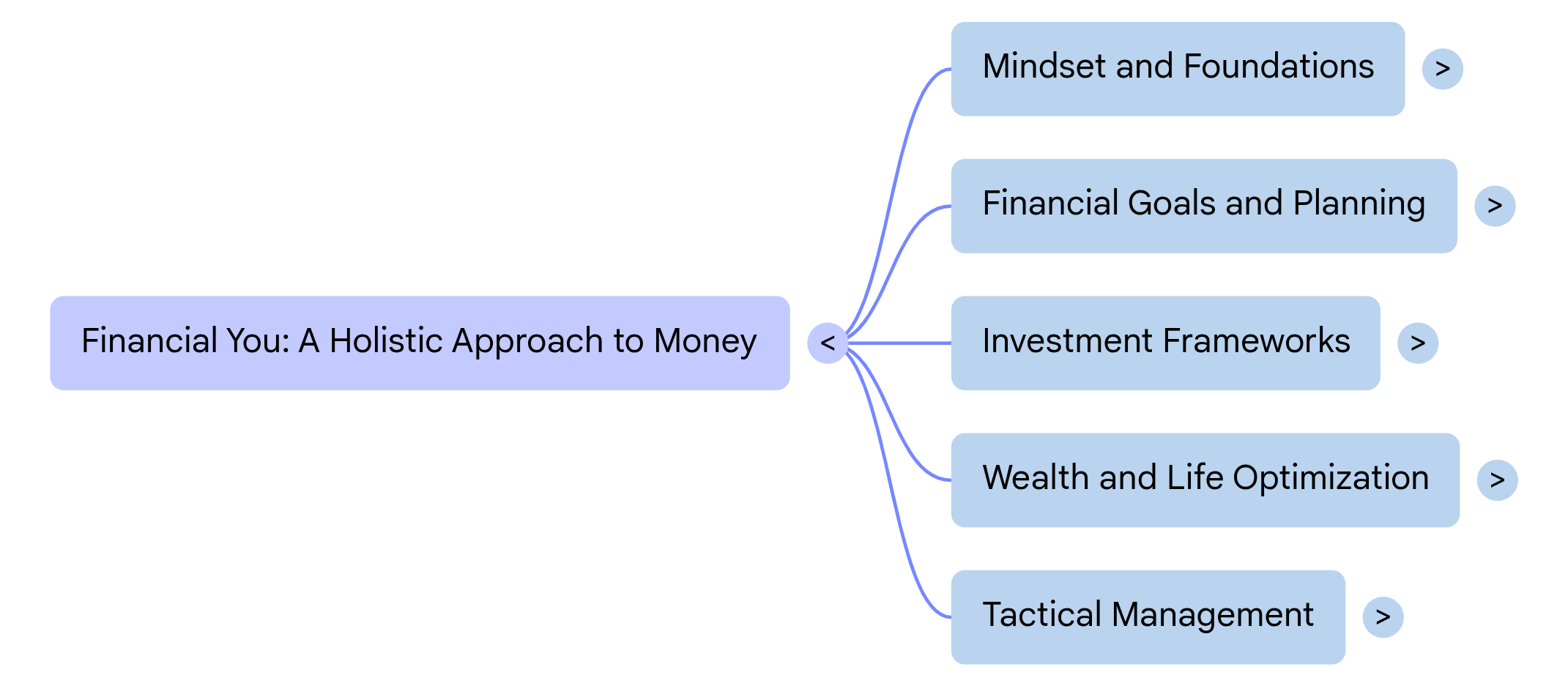
1. Mindset and Foundations
The AI correctly identified that everything starts here. I have always believed that before we can talk about spreadsheets or stocks, we have to talk about psychology.
In this pillar, we discussed that money is hard to talk about and how we need to reduce the shame surrounding it. We explored the difference between a fixed mindset and a growth money mindset, realizing that financial literacy is a skill we can learn, not a trait we are born with. We also tackled the mental traps that hold us back, like the sunk cost fallacy and the pessimism trap. The core takeaway? Optimism is a strategic choice.
2. Financial Goals and Planning
Once the mindset is right, we need a roadmap. This pillar is all about intentionality.
We established that specific financial goals are the fuel that drives our decisions. I introduced the concept of “paying yourself first“ not just as a saving trick, but as a way to prioritize your future self. We also looked at tools like the Family Cash Flow to visualize our trajectory and track our burn rate. This isn’t about restriction, it is about ensuring our spending aligns with our true goals and what we actually value.
3. Investment Frameworks
This is often the topic people want to jump to immediately, but it only works if the first two pillars are solid.
Here, I advocate for a specific approach: demystifying the stock market by owning the whole haystack. We discussed moving away from picking winners and toward Total Market Index Funds & ETFs to navigate uncertainty. We embraced the power of compounding and learned to navigate risk using the Bucket System, which ensures we have the right money ready for the right time horizon.
4. Wealth and Life Optimization
This might be my favorite pillar because it answers the question: “What is money for?”
We discovered that the ultimate dividend money pays is control over your time. We explored the concept of “memory dividends,” investing in experiences and relationships that compound in value as we age. We also discussed conscious spending, which gives us permission to spend lavishly on the things we love by cutting costs ruthlessly on the things we don’t.
5. Tactical Management
Finally, the last pillar groups together the “defense” strategies that protect what we build.
This includes treating our tax return as a tax report card that tells us how well our automated systems performed, ensuring we keep our money working for us all year. It covers debt management, insurance protection to shield us from the unpredictable, and navigating big life decisions like the rent vs. buy debate.
The Holistic View
Looking at these five pillars, I see a clear message. “Financial You” is about building a system where your mindset, your habits, and your investments work together to support a life of freedom and purpose.
Thank you for being part of the first 50 posts. Here is to the next 50, and to continuing this conversation together.
Let’s Talk Money!
Looking at the five pillars (Mindset, Goals, Investments, Life Optimization, Tactics), which one do you feel is your strongest area?
Which pillar have you neglected the most, and what is one step you can take to strengthen it?
As we look toward the next 50 posts, which of these areas would you like to explore deeper?
Oi Ro,
Comecei a te seguir por aqui.
Incrivel seu conteudo.
Parabéns!